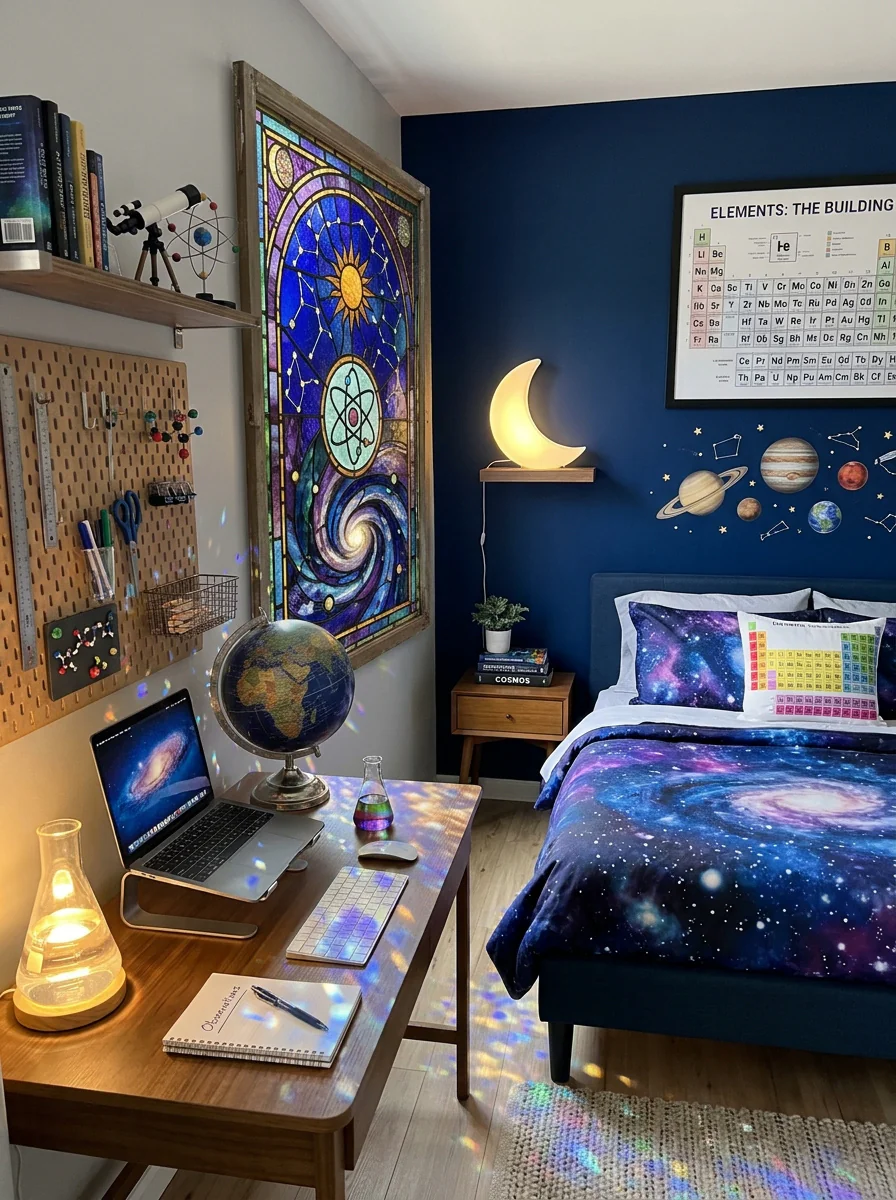
Science bedroom decor turns a bedroom into a place that sparks curiosity. Maybe your child wants a lab, a spaceship, or a dinosaur dig. Maybe you are an adult who loves stars, chemistry, or old scientific prints. Whatever your taste, a science theme gives you plenty of room to be creative, and it works at every age and budget.
The best part is that you do not need to turn the room into a classroom. A few smart pieces, such as a periodic table pillow, a night sky projector, framed scientist prints, and a pegboard desk, can create a room that is fun, calm, and useful. This guide shares science themed bedroom ideas for kids, teens, and grown ups, plus a full section on outer space and galaxy decor, storage ideas, DIY tips, and safety advice.
To create a science bedroom, pick one branch of science (such as space, chemistry, engineering, or nature), choose a calm color palette, add one focal wall with a mural, decal, or framed art, use science themed bedding and lighting, and set up a clutter free desk and storage. Keep the theme to a few strong pieces so the room still feels restful.
In this guide, you will learn:
- How to plan a science bedroom, step by step
- Science themed bedroom ideas by branch: lab, space, nature, and engineering
- Space themed bedroom and galaxy room decor ideas, including projector tips
- Science bedroom ideas for adults and aesthetic bedroom ideas
- Smart storage, desk, and display ideas
- Budget, DIY, and safety tips
What Is Science Bedroom Decor, and How Do You Plan It?
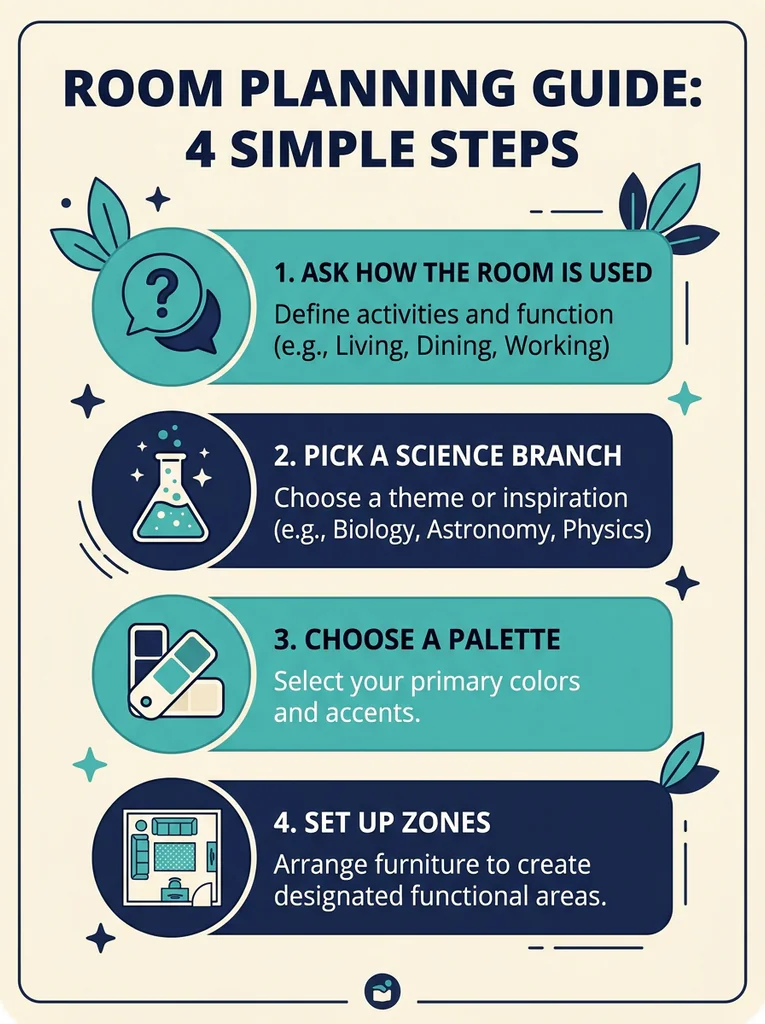
Science bedroom decor is a style that uses ideas, objects, and images from science to decorate a sleeping space. Decorative elements may include the periodic table, planets, microscopes, plants, dinosaurs, gears, and maps of the night sky. Rather than following one fixed style, this theme can be playful, colorful, calm, or sophisticated. For a softer, more natural feel, pampas grass bedroom decor can complement science-themed artwork with neutral textures and botanical accents.
Start by Asking How the Room Will Be Used
Before you buy anything, think about what the person in the room needs. One parent started by asking her son how he wanted to use his space, and the answers were simple: display his builds, have a place to draw and create, and keep things organized and easy to put away. Those three needs shaped the whole room. Ask yourself or your child:
- Do I need a desk for drawing, building, or homework?
- Do I need a place to display collections, projects, or souvenirs?
- How do I want the room to feel at night: calm, cozy, or exciting?
- Is this a long term room, or one that will change as interests change?
Pick One Branch of Science
A focused theme looks better than a mix of everything. Here are the main choices:
- Chemistry and the lab: Beakers, test tubes, the periodic table
- Space and astronomy: Planets, stars, galaxies, astronauts
- Physics and engineering: Gears, circuits, blueprints, inventors
- Biology and nature: Plants, anatomy, insects, ocean life
- Earth science and dinosaurs: Fossils, rocks, maps, minerals
You can mix two, such as a “lab and space” room, but keep one main idea.
Choose a Palette Before You Shop
A palette keeps the room from feeling busy. Three that work well:
- Cosmic: Navy, indigo, charcoal, and silver or gold
- Colorful lab: Deep green and bright blue with white and yellow accents
- Calm neutral: White, gray, black, and warm wood, with science themed prints
A colorful room works nicely if the child loves color. One boy’s room used a deep, velvety green and a bright ocean blue, and the other items, like a rug and painted canvases, repeated those colors so everything felt connected. Painting your own canvases with the room colors is an easy way to tie it together.
Think in Zones
Divide the room into zones: sleep, work and create, display, and storage. A clear layout keeps a themed room from feeling messy.
Science Themed Bedroom Ideas by Branch: Lab, Engineering, Nature, and More
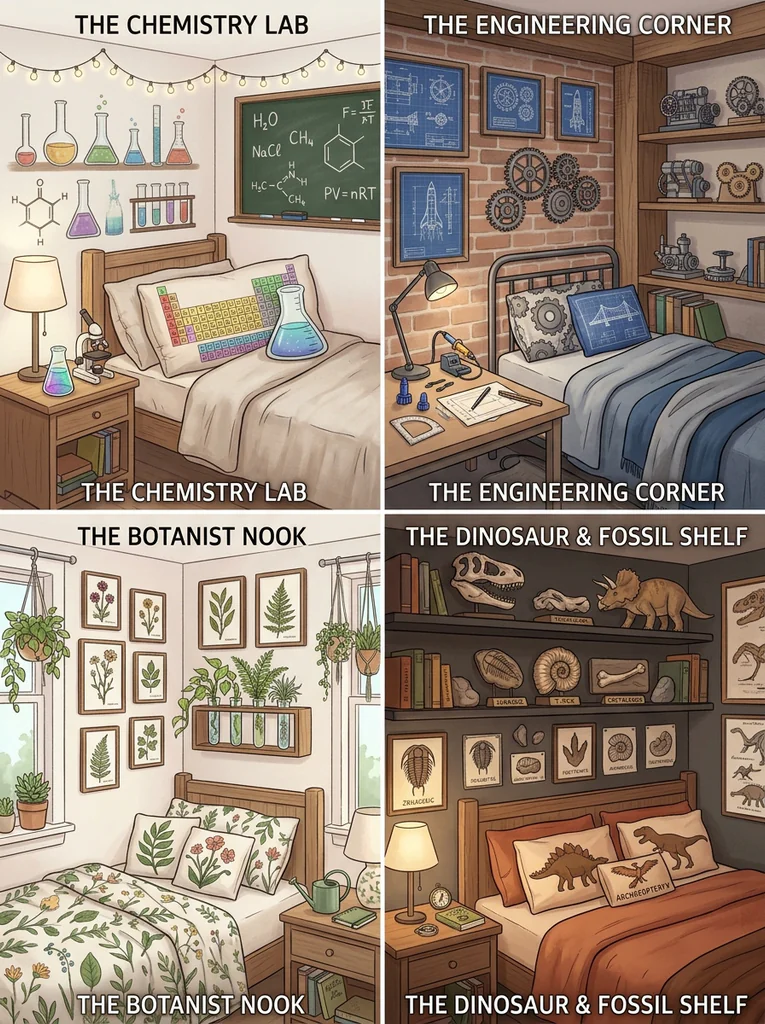
Here are science bedroom ideas you can mix and match.
Chemistry and Lab Style
- Beaker and test tube focus wall: A black and white mural or removable decal of chemical formulas, beakers, and molecules makes a strong backdrop.
- Periodic table accents: A periodic table pillow, print, or wall hanging shows off a love of science. A black and white wall pairs well with colorful periodic table pillows.
- Beaker lights: A lamp made from a beaker shape adds humor and glow.
- Test tube holders: Use them for pens, pencils, and crayons.
- Lab glass as decor: Use a flask as a vase for flowers, or an apothecary jar for collections.
- A stainless steel workbench look: A metal topped desk feels like a real lab and wipes clean easily. One family made a stainless steel desktop on a tiny budget, which shows you can get the look without spending much.
Physics and Engineering
- Gear decor: Wall gears, gear shaped clocks, and gear themed lamps give a mechanical feel.
- Inventor prints: Framed patent drawings, such as famous inventor patents, look neutral and smart. Because they are black and white, they do not feel busy.
- Neon atom light: An atom shaped light gives a soft glow without turning on the ceiling light.
- Plasma ball or lava lamp: These classic science toys also work as night lights.
- Building display: A shelf for LEGO or model builds shows off projects. Many families build their own display shelves for much less than ready made ones.
Biology and Botany
- Plants in test tubes: Propagate cuttings in small glass tubes on a wall rack or windowsill.
- Pressed flower frames: Frame real pressed flowers with their Latin names.
- Botanical prints: Floral or leaf drawings with scientific labels look lovely and calm.
- Insect and butterfly art: Use framed prints or shadow boxes. Choose printed images, and skip real specimens if you can.
- Anatomy and medical themes: Prints of the heart, skeleton, or microscope slides suit a future doctor or nurse.
Earth Science and Dinosaurs
- Fossil shelf: Display real or replica fossils, rocks, and minerals in a shadow box. A thrift store shadow box is perfect for small treasures.
- Dinosaur wall art: Use a mural, decal set, or framed skeleton print.
- Maps and globes: A vintage world map or a globe bowl adds depth and a travel feel.
- Souvenir display: Shelves for rocks and gifts from trips make learning personal.
Science Nursery
The theme can start early. Choose mobiles with planets, stars, or animals, soft prints of the moon and clouds, and a simple periodic table or alphabet of animals. Keep small parts out of reach of babies.
It Works for Everyone
Science themes are not just for boys. A room for a young scientist can be soft and floral, bold and bright, or dark and moody. Choose colors and styles that match the person, not an old idea of what “should” suit them.
Space Themed Bedroom: Outer Space Bedroom Decor and Galaxy Lighting
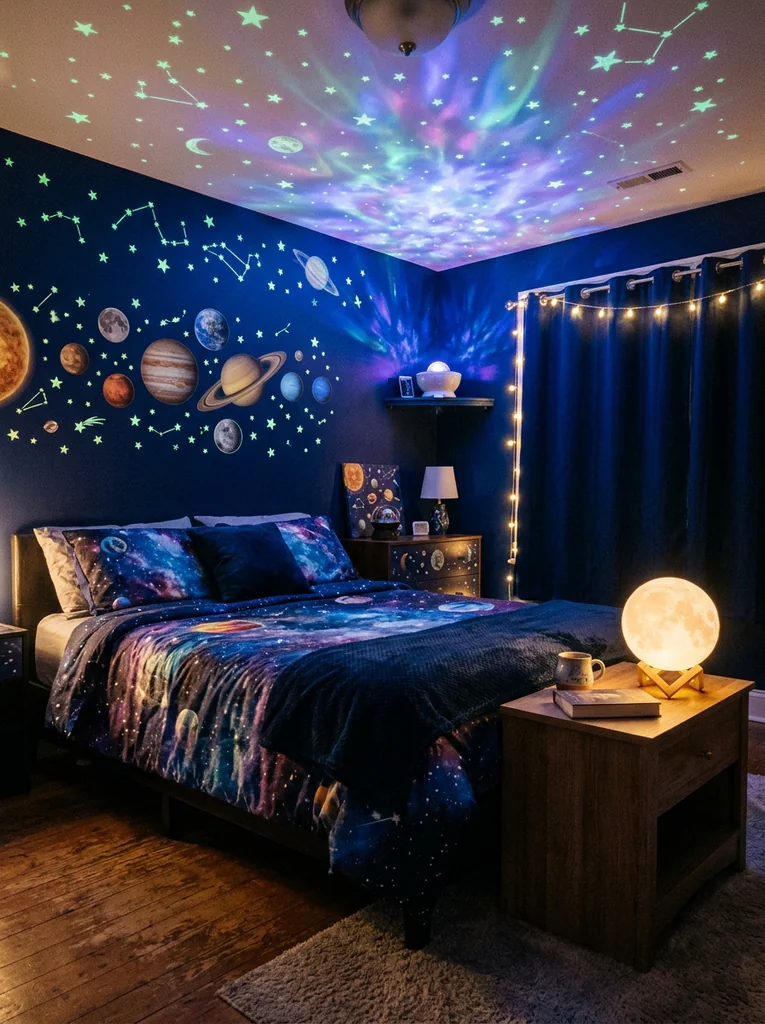
A space themed bedroom is one of the most popular ways to decorate with science. It can feel playful for a child, dreamy for a teen, or sleek for an adult. Here is how to build outer space bedroom decor that looks great.
Start With the Walls
- Deep colors: Navy, midnight blue, indigo, and charcoal feel like the night sky. A deep color on one wall is enough.
- Ombre or nebula paint: Blend purple, blue, and pink in soft layers for a galaxy room decor look.
- Murals: A large space mural can turn the whole wall into a scene, even a spaceship interior. It works as your focal point.
- Decals: Removable planet, rocket, and star decals are a good choice for renters and fast changers.
- Space wall decor: Hang framed star maps, moon phase prints, astronaut art, and photos of nebulae and planets. Many NASA images are free to use, but check NASA’s media guidelines before printing.
Add the Ceiling
- Glow in the dark stars: Stick them on the ceiling in a loose scatter. They charge from room light and fade over a few hours, so they work best as a gentle effect.
- Hanging planets: Paper or foam planets in a mobile make a fun feature. Hang them in the right order from the Sun: Mercury, Venus, Earth, Mars, Jupiter, Saturn, Uranus, and Neptune.
- Constellation stickers: Place real constellations such as the Big Dipper or Orion, and your child can learn them.
Choose Space Bedding and Textiles
- Galaxy print sheets and comforters bring in the look fast.
- Solar system bedding makes the mood clear.
- A solid pillow in the curtain color keeps the bed from looking too busy.
- A periodic table pillow adds a nice mix of space and chemistry.
- Room darkening curtains block morning light and make projector effects stand out.
Light the Room With Galaxy Decor for Bedroom Style
Lighting makes space decor feel real.
- Galaxy projector: Casts stars and nebulae on the ceiling and walls.
- Neon or LED signs: An atom or planet shaped light works as a night light.
- Moon lamp: A glowing moon on a shelf feels calm.
- Fairy lights: A string of small lights over a headboard or canopy looks like stars.
- Lava lamp: Slow moving colors look cosmic.
- LED strips: Hide them behind a shelf or headboard for a soft purple or blue glow.
How to Use a Galaxy Projector
A galaxy or hologram projector is a night light that casts moving stars and clouds on your walls. Here is how to get the best results.
- Pick the right model. Look for interchangeable discs or scenes (galaxy, nebula, moon, aurora), a slow rotation, a timer, and adjustable brightness.
- Place it well. Set it on a stable shelf or nightstand about a few feet from the surface you want to cover. Angle it at the ceiling for a wide sky effect. Many cover a medium sized bedroom.
- Use the timer. A sleep timer turns it off after a set time so it does not run all night.
- Keep it dim for sleep. Bright, busy light can make it harder to fall asleep. Choose a soft setting or warm tones at bedtime.
- Dark rooms work best. Close curtains so the stars show up.
- Mix with other light. A lamp for reading, and a projector for winding down.
- Mind the cord. Keep cables away from the bed and use a wall plug or a safe cord cover.
- Check the ventilation. Do not cover the device.
One family said their night sky projector was “totally unnecessary, but very fun,” and that the slow rotation was calming. That is the right attitude: it is a bonus, not a must have.
Space Decorations for Bedroom Shelves and Desks
- A small telescope or a pair of binoculars
- A globe or star globe
- Rocket and shuttle models
- An astronaut figure or helmet lamp
- A star chart or moon phase calendar
- A glass jar of “stardust” (glitter in water) for a calming sensory piece
Science Bedroom Ideas for Adults and Aesthetic Bedroom Ideas
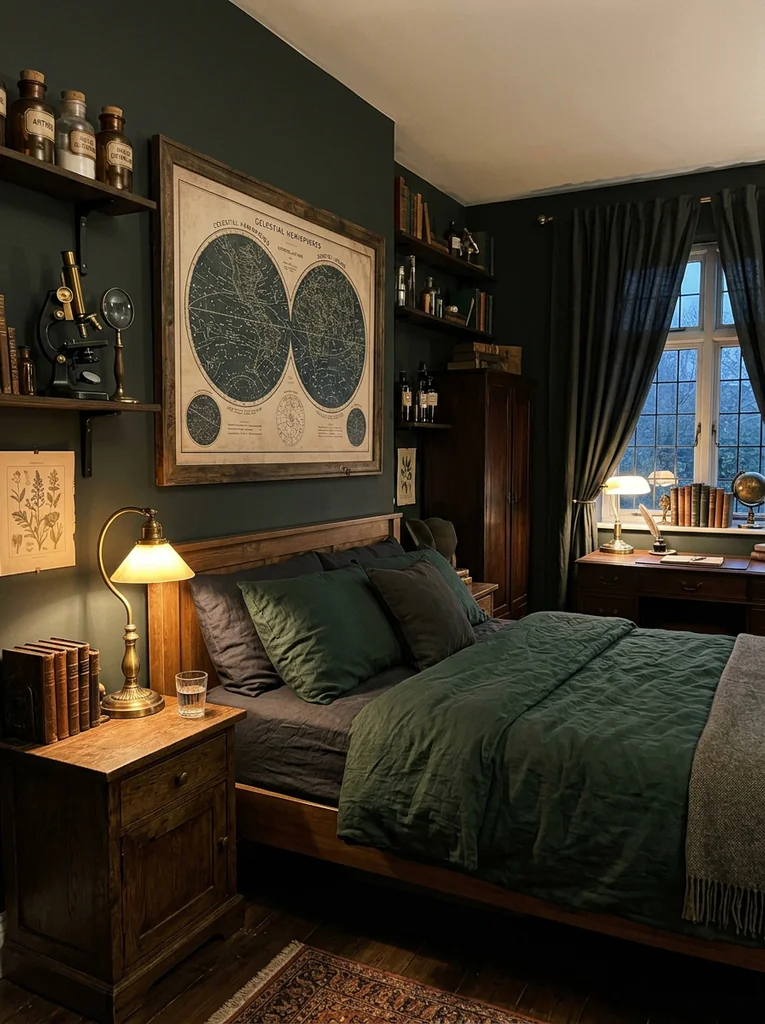
Science bedroom ideas for adults are less about cartoons and more about mood, materials, and fine details. These aesthetic bedroom ideas feel grown up and calm.
Dark Academia Science
- Palette: Deep green, navy, charcoal, or burgundy walls with warm wood and brass
- Art: Vintage botanical plates, star charts, anatomy drawings, and old maps in dark frames
- Objects: An antique microscope, a brass telescope, a globe, apothecary jars, and stacks of old books
- Lighting: Brass desk lamps, warm bulbs, and a glass shade
- Bedding: Linen, wool, or velvet in deep tones
Cosmic Minimal
- Palette: Soft black, gray, and cream with one silver or gold accent
- Art: A single large moon print, a star map of a special date, or a framed photo of a galaxy
- Lighting: A moon lamp and a small projector set to a gentle mode
- Bedding: Plain linen in a dark shade
- Rule: Fewer pieces, more space
Laboratory Chic
- Materials: Glass, steel, white tile look, and black frames
- Objects: Glass beakers as vases, a steel shelf, and a clean desk
- Art: Periodic table print in black and white, molecule drawings, and clean typography
- Colors: White, gray, and one bright accent such as teal or yellow
Celestial Boho
- Palette: Warm earth tones with deep blue and gold
- Textiles: A moon and star tapestry, macrame, and woven baskets
- Plants: Trailing pothos and a small cactus
- Lighting: Fairy lights and candles in glass holders (use flameless if you can)
Retro NASA
- Palette: White, orange, navy, and gray
- Art: Vintage space program posters and rocket diagrams
- Objects: A retro clock, a metal desk, and a model rocket
Tips for an Adult Space
- Choose quality over quantity. A few fine pieces look better than many cheap ones.
- Mix one science item with everyday decor, so the room does not look like a theme park.
- Keep colors muted and use texture for interest.
- Add art you can read. Scientific illustrations and star charts invite a second look.
- Make the bed the calm center. Keep it simple and soft.
Smart Storage, Desk, and Display Ideas for a Science Bedroom
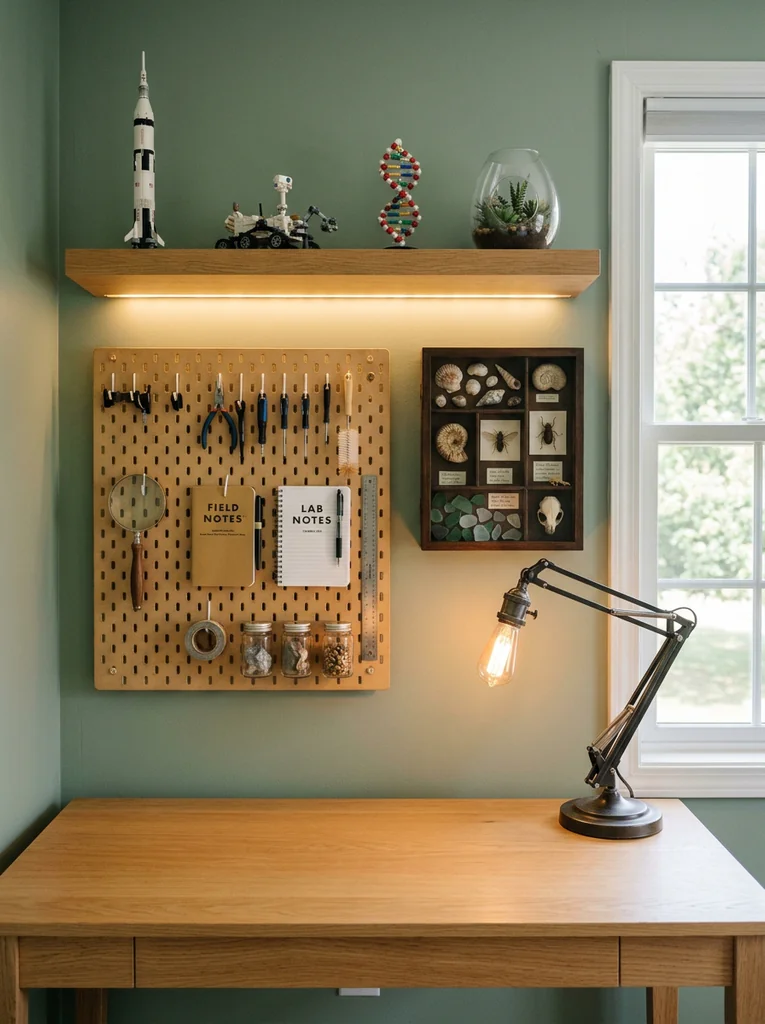
A themed room works only if it stays organized. Storage is what keeps the fun from turning into clutter.
Build a Create Zone
For kids and teens who draw, build, and experiment, the desk area is the most important part of the room.
- Pegboard: It uses wall space, makes items easy to see, and keeps the desk clear. A pegboard with bins, hooks, and shelves lets the child put things back where they belong.
- Keep the desk free. Put only a lamp, a lava lamp, or one favorite item on the desktop.
- Under shelf lights: Small LED puck lights under the bottom shelf brighten the work area.
- Easy wipe surface: A metal or laminate top handles slime, glue, and paint.
Use Shelves Smartly
- Bottom shelves: Keep the things used every day within easy reach.
- Top shelves: Use them for display items and trophies.
- Display builds: LEGO or model shelves show off projects without taking over the room.
- Shadow box: A thrifted shadow box holds mini figures, rocks, and small treasures.
- Souvenir shelf: Gifts from trips and rock finds become part of the room’s story.
Hide the Clutter
- Over the door organizer: One with clear bins lets your child see what is inside.
- Under bed bins: Use flat bins that hide behind a long comforter.
- Book bin: A fabric bin near the bed holds current reads. A simple rule helps: the bin holds only as many books as fit.
- Baskets and cubes: Label them with science words like “Robotics” or “Rocks.”
- No closet? Use a freestanding wardrobe, a locker style cabinet, or an antique chifforobe. A restored old wardrobe can become a standout piece.
Make It Easy to Change
Interests shift fast. Choose a neutral base such as white, gray, or navy walls and furniture, then swap the science items as your child grows. Decals, framed prints, pillows, and lamps are easy to change. Murals and built ins take more effort, so choose those only if the interest is likely to last.
Budget, DIY, and Safety Tips for Science Bedroom Decor
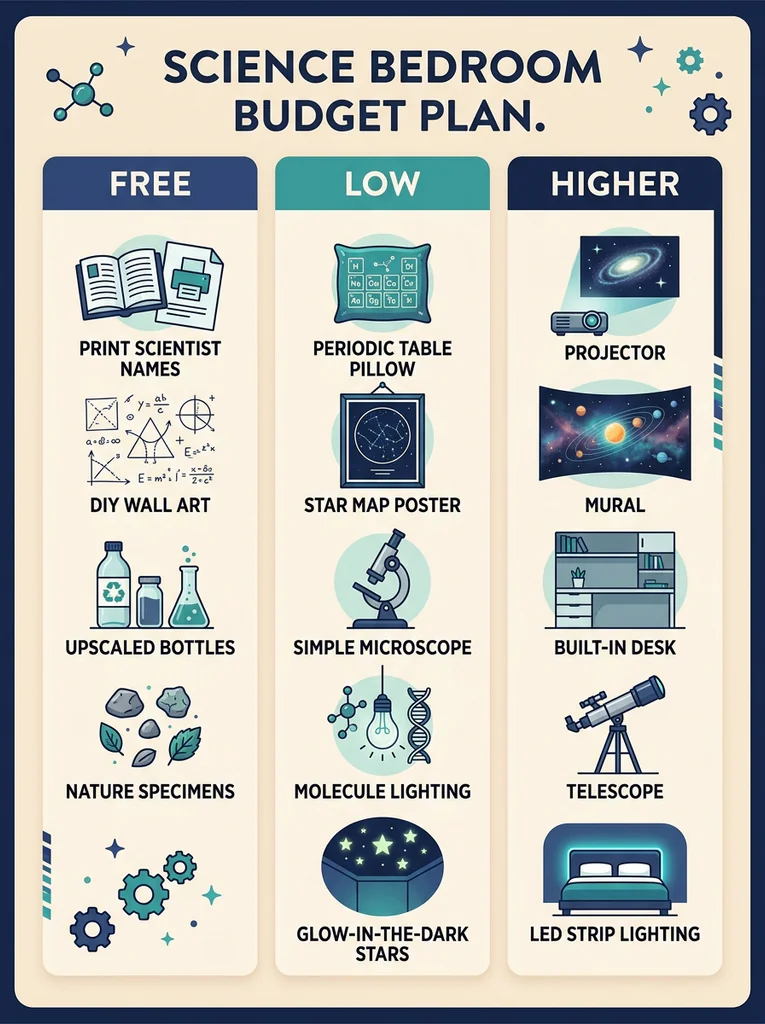
You can build a great science room without spending a lot.
Budget Plan
- Free: Print the names of famous scientists and frame them. Print a free periodic table. Rearrange furniture to create a desk zone. Gather rocks, leaves, and shells for display.
- Low cost: Add removable wall decals, glow stars, a periodic table pillow cover, a lava lamp, and a thrifted shadow box. Yard sales and thrift stores are great for globes, frames, lamps, and old photos.
- Medium: Add galaxy or solar system bedding, room darkening curtains, a pegboard desk wall, a night sky projector, and framed prints.
- Higher: Add a wall mural, custom shelves, a built in desk, and a quality bed and mattress.
Easy DIY Ideas
- DIY display shelves for LEGO or models
- Painted canvases using the room colors
- A mobile of planets made from foam balls and fishing line
- A moon phase garland made from paper or felt
- A chalkboard wall for equations and sketches
- Test tube planters with cuttings
- Painted chair or stool with rag rug cushions, so the colors match the room
- A homemade star map of a birthday or special date
Renter Friendly Choices
Use removable decals, adhesive strips, leaning frames, and plug in lights. Skip permanent paint or murals unless your lease allows it.
Safety First
Science themes are fun, but safety matters, especially with kids.
- Anchor tall furniture and shelves to the wall so they cannot tip.
- Use plastic glassware or sealed jars for kids’ rooms. Keep real glass beakers for adult rooms.
- Never store real chemicals in decor. Use empty, clean containers only.
- Choose non toxic items for glow stars and craft supplies, and keep small parts away from toddlers.
- Secure cords and keep them off the bed and out of walkways.
- Check hot items. Lava lamps and projectors should have space to cool.
- Hang heavy frames properly, and avoid heavy glass over the bed.
- Follow age labels on all products.
Mistakes to Avoid
- Too many themes at once. Pick one main idea.
- Too much color and pattern. Balance busy bedding with simple walls.
- Ignoring storage. Clutter ruins any theme.
- Making the room too bright at night. Use warm, dim lights for sleep.
- Buying only trendy pieces. Choose items that will last as tastes change.
- Forgetting the person. Let the child or the adult choose favorite items.
Frequently Asked Questions
What is science bedroom decor?
Science bedroom decor is a theme that uses science related art, colors, and objects such as the periodic table, planets, beakers, gears, and plants to decorate a bedroom. It can be playful for kids or elegant for adults, and it works best with one main branch of science and a clear color palette.
How do I make a space themed bedroom?
Start with deep blue or charcoal walls, add planet or star decals, stick glow in the dark stars on the ceiling, and choose galaxy or solar system bedding. Add a galaxy projector or moon lamp for soft light, and finish with framed space prints and a clutter free desk.
What are good science bedroom ideas for adults?
Try dark academia with deep green walls, vintage botanical or star chart prints, brass lamps, and an antique microscope or globe. You can also try a cosmic minimal look with a single large moon print, or a laboratory chic style with glass, steel, and black and white prints.
Is a galaxy projector good for sleep?
A galaxy projector can feel calming, but bright or busy light may make it harder to fall asleep. Choose a dim setting with warm colors, use the sleep timer, and turn it off if it keeps you awake. If you have trouble sleeping, talk to a doctor.
How can I decorate a science bedroom on a budget?
Start with free or cheap items: print scientist names or a periodic table and frame them, add removable decals, glow stars, and a pillow cover. Shop yard sales and thrift stores for globes, frames, and shadow boxes, and build your own shelves. Spend money on bedding, curtains, and a desk first.
Conclusion
Science bedroom decor works because it makes a room personal. It can show a love of stars, chemistry, dinosaurs, plants, or gears, and it can grow along with the person who sleeps there. Incorporating bedroom office decor that complements the science theme, such as a functional desk, organized shelves, and focused lighting, creates a space for both learning and relaxation. The best rooms use a clear theme, a calm palette, good lighting, and smart storage, with a few standout pieces that spark joy.
Ready to begin? Pick one branch of science today, choose your palette, and make a short list of three items: one wall piece, one bedding or pillow item, and one light. Add storage and a clear desk, and then let the room grow over time. Take a “before” photo, share your finished room with a fellow science fan, and enjoy a bedroom that feels curious, calm, and entirely yours.